

In recent years, heterostructures combining topological and magnetic materials have emerged as an important material platform for terahertz (THz) emission because of their rich band structures, pronounced interfacial effects, and ultrafast spin dynamics. In the conventional physical picture, femtosecond laser excitation typically generates an ultrafast spin current in the magnetic layer, which is then converted into a transient charge current via spin-to-charge conversion in an adjacent material, thereby radiating THz waves. However, as research in this area has progressed, the THz responses observed in some topological-material/ferromagnet heterostructures cannot be fully explained by spin-to-charge conversion alone. Whether the intrinsic band structure of topological materials and interfacial nonlinear photocurrents can become the dominant source of THz radiation therefore remains an important question to be clarified.
To address this question, Prof. Biaobing Jin and Prof. Caihong Zhang of Academician Peiheng Wu’s team at the Research Institute of Superconductor Electronics, Nanjing University, in collaboration with Prof. Xuefeng Wang’s group at Nanjing University and Prof. Ke Xia’s group at Southeast University, systematically investigated THz emission from heterostructures composed of the Dirac semimetal PtTe2 and ferromagnetic Cr5Te6. The experiments showed that the heterostructure produced a markedly enhanced THz signal compared with individual PtTe2 and Cr5Te6 films. Further polarization-resolved measurements revealed that, even without an external magnetic field, simply reversing the helicity of the incident circularly polarized light reversibly switched the polarity of the emitted THz signal. The THz signal also exhibited clear signatures of a second-order nonlinear photocurrent, indicating that the circular photogalvanic effect (CPGE) is an important THz generation mechanism in this system.
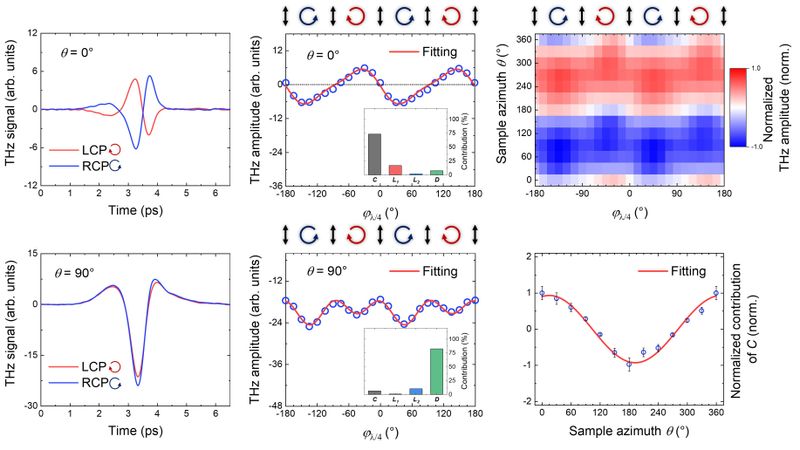
Figure 1. Magnetic-field-free THz emission from a PtTe2/Cr5Te6 thin-film heterostructure. Reversing the helicity of circularly polarized light enables reversible switching of the THz signal polarity and produces a pronounced dependence on the sample azimuthal angle.
To further identify the origin of the THz signal, the research team performed magnetic-field reversal, front- and back-side excitation, and Co/PtTe2 control experiments, and decomposed the THz signals measured under opposite magnetic fields into field-even and field-odd components. The results showed that the field-odd component in PtTe2/Cr5Te6 was much smaller than the field-even component, whereas the spin-to-charge-conversion-dominated Co/PtTe2 control sample exhibited a pronounced magnetic-field-dependent polarity reversal. These observations rule out spin-to-charge conversion and the magneto-photogalvanic effect as the dominant contributions, demonstrating that the THz emission from PtTe2/Cr5Te6 originates primarily from photoinduced currents at the heterointerface.
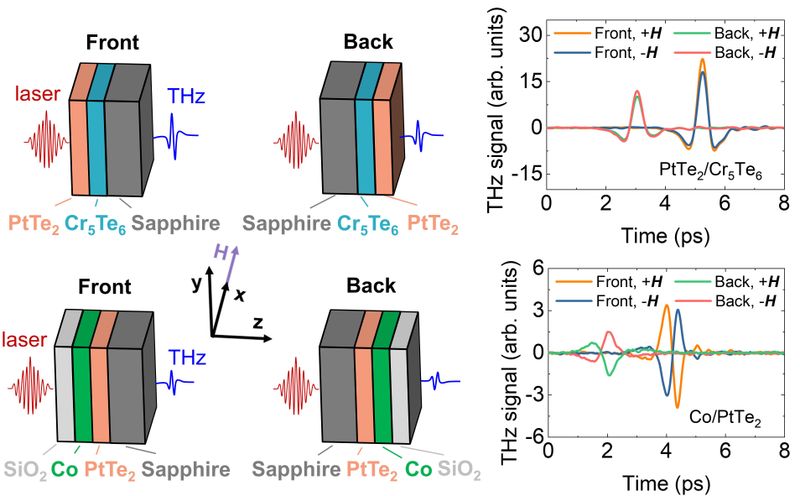
Figure 2. Comparison of THz emission from PtTe2/Cr5Te6 and Co/PtTe2. The former is insensitive to magnetic-field reversal, whereas Co/PtTe2 exhibits the characteristic field-dependent polarity reversal, indicating that the two systems are dominated by different THz generation mechanisms.
Building on these results, the research team combined the experiments with first-principles calculations to further investigate the microscopic origin of the interfacial photocurrent. The calculations showed that introducing Cr5Te6 significantly alters the local structure and electronic states of PtTe2 near the interface and induces pronounced spin splitting in the PtTe2 bands adjacent to the interface, demonstrating substantial interfacial modulation of the electronic structure. Together with the experimental results, the interfacial band reconstruction provides the conditions for helicity-dependent selective optical transitions: circularly polarized light with opposite helicities generates different asymmetric carrier distributions in momentum space, giving rise to an ultrafast photocurrent whose direction reverses with light helicity and thereby enabling controllable switching of the THz polarity.
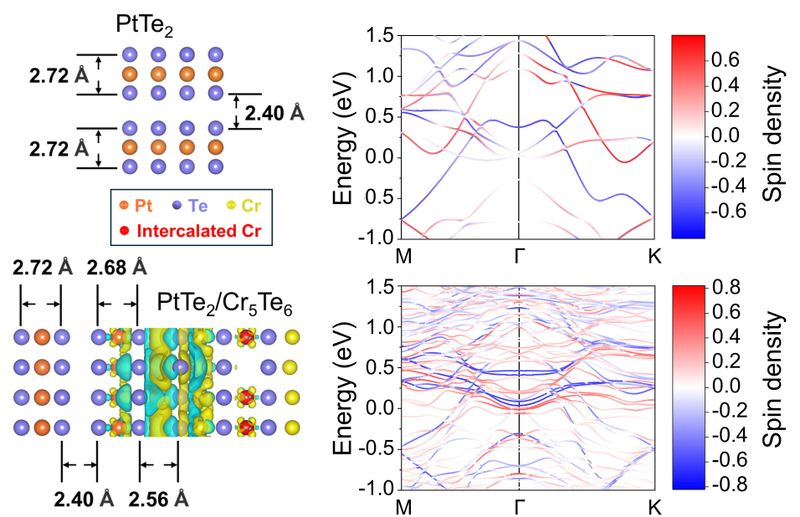
Figure 3. Structural and band-structure modulation at the PtTe2/Cr5Te6 thin-film heterointerface. Interfacial coupling reconstructs the electronic states and induces pronounced spin splitting of the bands, providing the conditions for helicity-dependent photocurrent generation.
This study demonstrates that, in topological-material/ferromagnet heterostructures, interfacial band-structure engineering can make the photogalvanic effect the dominant THz generation mechanism, providing new insight into ultrafast photocurrents and THz radiation in such heterostructures. Moreover, controlling the THz polarity through light helicity without reversing an external magnetic field opens a new route toward magnetic-field-free, all-optical control of THz radiation sources.
The findings were published in Physical Review Letters under the title “Enhanced Terahertz Emission Enabled by Circular Photogalvanic Effect” and were selected as an Editors’ Suggestion. Prof. Biaobing Jin, Prof. Caihong Zhang, and Prof. Xuefeng Wang of Nanjing University and Prof. Ke Xia of Southeast University are co-corresponding authors. Da Tian, a PhD student at the Research Institute of Superconductor Electronics, Nanjing University; Associate Prof. Lei Wang of Southeast University; and Zhongqiang Chen, a postdoctoral researcher at Nanjing University, are co-first authors. Academician Peiheng Wu, Prof. Jian Chen, Prof. Huabing Wang, Prof. Jingbo Wu, and Associate Prof. Kebin Fan of the School of Electronic Science and Engineering also made important contributions to the work. The research was supported by the National Natural Science Foundation of China, the National Key Research and Development Program of China, and relevant research programs of Jiangsu Province.
Paper information: D. Tian, L. Wang, Z. Chen, A. Song, K. Xu, Z. Jiang, J. Huang, W. Zhang, L. Wang, J. Liu, Q. Li, Z. Chen, J. Wu, K. Fan, H. Wang, J. Chen, P. Wu, C. Zhang, X. Wang, K. Xia, and B. Jin, "Enhanced Terahertz Emission Enabled by Circular Photogalvanic Effect," Phys. Rev. Lett. 137, 116904 (2026).
Article link: https://journals.aps.org/prl/abstract/10.1103/zlmj-gpj9
