

Flexible wearable electronic devices have shown great promise for applications in health monitoring, motion recognition, electronic skin, and human-machine interaction in recent years. High-performance flexible sensors, in particular, are key devices for acquiring multidimensional physiological and environmental information. Compared with single-modal strain or temperature sensors, strain-temperature bimodal sensors have the ability to simultaneously perceive human motion, skin conditions, and changes in the external thermal environment, and therefore provide richer information and greater application value in intelligent wearable systems. However, existing strain-temperature bimodal sensors still face a core challenge: if the same sensitive material or conductive channel is used to achieve bimodal responses, significant signal crosstalk often occurs; if the strain and temperature sensing units are integrated separately, multiple heterogeneous materials, complex stacked structures, and multi-step fabrication processes are usually required, thereby increasing device size, interconnection complexity, and system integration difficulty.
To address this challenge, Professor Linwei Yu’s group from the School of Electronic Science and Engineering, Nanjing University, proposed a morphology-programmable design strategy for orthogonally aligned silicon nanowire (SiNW) arrays based on their independently developed in-plane solid-liquid-solid (IPSLS) growth mechanism, and successfully constructed a strain-temperature bimodal flexible sensor. The device integrates two types of functional channels on the same SiNW material platform: serpentine SiNW channels parallel to the stretching direction are used for high-sensitivity strain sensing, while straight SiNW channels perpendicular to the stretching direction are used for temperature detection. Through orthogonal alignment, the structure reduces signal crosstalk between strain and temperature. The team realized the controllable growth of serpentine and straight SiNWs and transferred them onto a flexible polyimide (PI) substrate to complete device integration. Finite element simulation and electrical measurements demonstrate that the orthogonally aligned structure can effectively achieve strain-temperature decoupling. The final bimodal sensor exhibits a gauge factor (GF) of up to 155, a temperature detection range of 20-97 ℃, and maintains stable output after 40,000 cycles under 0.3% strain. Furthermore, by combining a 3×3 sensor array with a convolutional neural network (CNN) model, the device achieves approximately 95% classification accuracy under complex strain-temperature coupled stimuli, and has been successfully applied to wearable scenarios such as body-surface temperature monitoring during exercise, wrist motion detection, and elbow motion detection. This work provides a new technical route for highly integrated, low-crosstalk, and intelligent multimodal flexible sensing systems.
Figure Guide
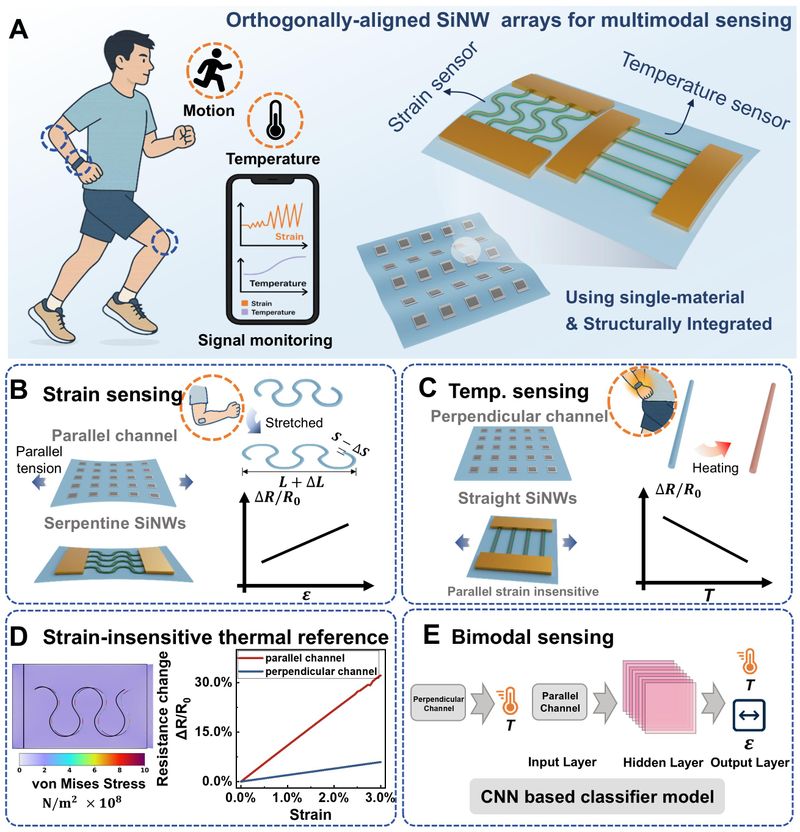
Figure 1. Concept and working principle of the orthogonally aligned SiNW strain-temperature bimodal sensor.
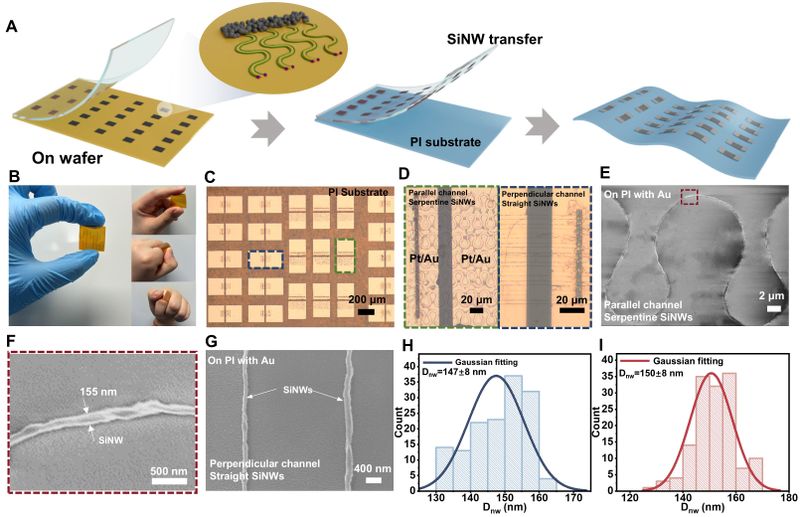
Figure 2. Fabrication process and characterization of the morphology-programmable orthogonally aligned SiNW arrays.
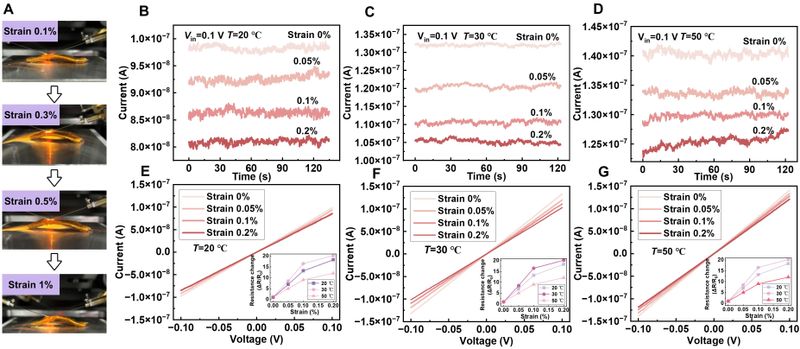
Figure 3. Electrical response of the serpentine strain-sensing channel and corresponding electrical performance after stretching.
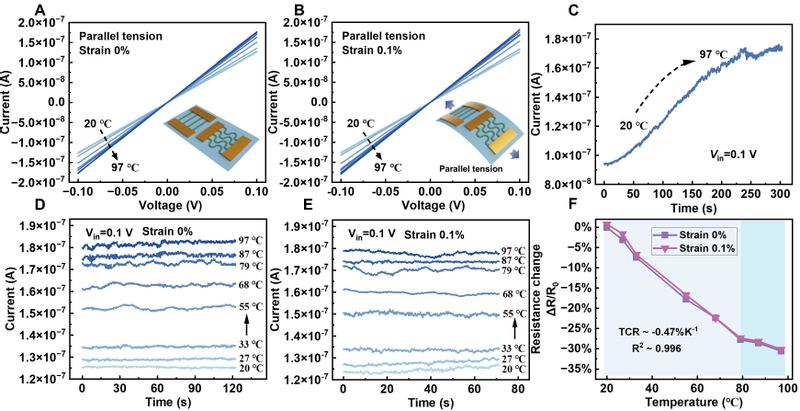
Figure 4. Temperature response and decoupling verification of the straight temperature-sensing channel.
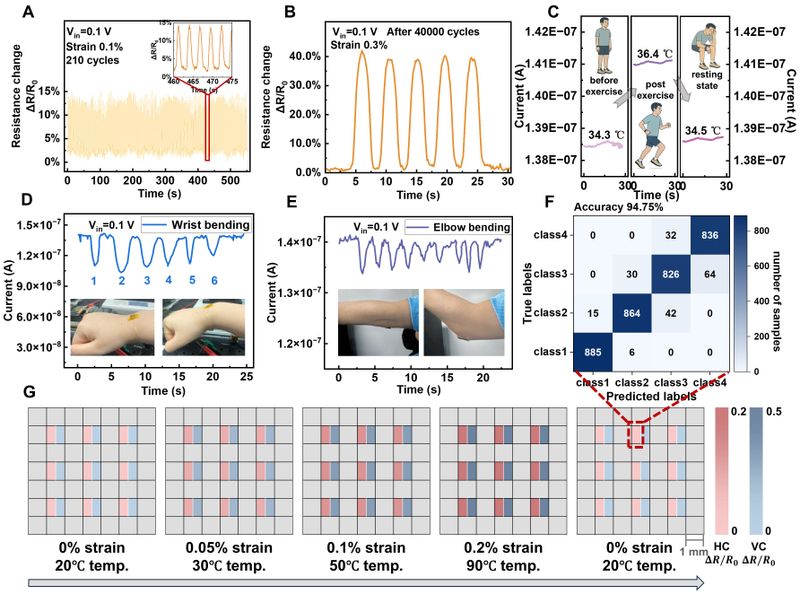
Figure 5. Cyclic stability, wearable application demonstration, CNN classification, and array-level demonstration of the bimodal sensor.
Recently, this research work was published in Nano Letters under the title “Morphology-Programmable Orthogonally Aligned Silicon Nanowire Arrays for Integrated Strain-Temperature Bimodal Sensing”. Associate Researcher Xiaopan Song from the School of Electronic Science and Engineering, Nanjing University, and Zhenlei Qin from Soochow University are the co-first authors of the paper. Professor Linwei Yu and Professor Junzhuan Wang from the School of Electronic Science and Engineering, Nanjing University, and Dr. Sheng Wang from the College of Electronic and Optical Engineering and the College of Flexible Electronics (Future Technology), Nanjing University of Posts and Telecommunications, are the co-corresponding authors. This work was supported by Professor Kunji Chen, Professor Yi Shi, and Professor Jun Xu from Nanjing University, and Professor Jing Chen from Nanjing University of Posts and Telecommunications. The work was funded by the National Natural Science Foundation of China for Distinguished Young Scholars, National Natural Science Foundation of China, National Basic Research Program of China, and Natural Science Foundation of Jiangsu Province. The authors sincerely acknowledge all of the support.
Paper Information:
Morphology-Programmable Orthogonally Aligned Silicon Nanowire Arrays for Integrated Strain-Temperature Bimodal Sensing.
Xiaopan Song1#, Zhenlei Qin2#, Sheng Wang3*, Yang Gu1, Jincheng Liu2, Qi Zhou2, Junyu Fan1, Junyang An1, Jing Chen3, Junzhuan Wang1*, Yi Shi1, Linwei Yu1,3*
Corresponding Authors: Sheng Wang, Junzhuan Wang, Linwei Yu
Nano Letters, DOI: 10.1021/acs.nanolett.6c00850 (2026)
Previous Related Work:
1. Scalable integration of high sensitivity strain sensors based on silicon nanowire spring array directly grown on flexible polyimide films. Xiaopan Song, Yang Gu, Sheng Wang*, Junyu Fan, Junyang An, Lei Yan, Bin Sun, Junzhuan Wang, Linwei Yu*, Nano Lett. 25 (2025) 2290−2297.
2. Direct Growth and Integration of Silicon Nanowire Transistors on Polymer Substrates. Xiaopan Song, Junyu Fan, Bin Sun, Yang Gu, Sheng Wang, Junyang An, Duanwangde Liu, Junzhuan Wang, Linwei Yu*, ACS Appl. Mater. Interfaces 17 (2025) 48503-48510.
3. Highly Stretchable High-Performance Silicon Nanowire Field Effect Transistors Integrated on Elastomer Substrates. Xiaopan Song, Ting Zhang, Lei Wu, Ruijin Hu, Wentao Qian, Zongguang Liu*, Junzhuan Wang, Yi Shi, Jun Xu, Kunji Chen, Linwei Yu*, Adv. Sci. 9 (2022) e2105623.
4. Highly Sensitive Ammonia Gas Detection at Room Temperature by Integratable Silicon Nanowire Field-Effect Sensors. Xiaopan Song, Ruijin Hu, Shun Xu, Zongguang Liu*, Junzhuan Wang, Yi Shi, Jun Xu, Kunji Chen, Linwei Yu*, ACS Appl. Mater. Interfaces 13 (2021) 14377-14384.
5. High‐Performance Transparent Silicon Nanowire Thin Film Transistors Integrated on Glass Substrates via a Room Temperature Solution Passivation. Xiaopan Song, Lei Wu, Yifei Liang, Zongguang Liu*, Junzhuan Wang, Jun Xu, Kunji Chen, Linwei Yu*, Adv. Electron. Mater. 9 (2023) 2201236.
6. Flexible silicon for high-performance photovoltaics, photodetectors and bio-interfaced electronics. Shuyi Wang, Xiaopan Song*, Jun Xu*, Junzhuan Wang, Linwei Yu*, Mater. Horiz. (2025) DOI: 10.1039/d4mh01466a.
7. Ultracompact single-nanowire-morphed grippers driven by vectorial Lorentz forces for dexterous robotic manipulations. Jiang Yan, Ying Zhang, Zongguang Liu, Junzhuan Wang, Jun Xu*, Linwei Yu*, Nat. Commun. 14 (2023) 3786.
8. Step-necking growth of silicon nanowire channels for high performance field effect transistors. Lei Wu, Zhiyan Hu, Lei Liang, Ruijin Hu*, Junzhuan Wang*, Linwei Yu*, Nat. Commun. 16 (2025) 965.
Research Group Profile: https://ese.nju.edu.cn/ylw
