

On March 9, 2026, a research team led by Associate Professor Changjin Wan from the group of Academician Yi Shi at the School of Electronic Science and Engineering, Nanjing University, in collaboration with Nanyang Technological University, Singapore and other research institutions, published a research paper entitled “An iontronic reservoir for highly robust neuromorphic prosthesis” in Nature Materials (Fig. 1, DOI: 10.1038/s41563-026-02532-7).
Figure 1. First page of the article.
After an octopus’s arm is severed, it can still regenerate and restore its sensory and motor functions. For most animals, however, the repair capacity of internal nerve tissue is far inferior to that of epidermal tissue. The research team aimed to realize and enhance the repair capacity of artificial nerves by constructing neuromorphic prostheses. They developed a neuromorphic device with ultra-fast functional recovery (<0.02 s). As one of the core computing units, this device achieves high-efficiency recognition of various complex targets (recognition accuracy >90%) and was further used to build an artificial sensorimotor loop that can autonomously regulate command execution intensity according to the level of muscle fatigue. This work provides a new strategy for the development of next-generation implantable neuroelectronic devices, embodied intelligence, and precision medicine.
A neural prosthesis is an implantable neuroengineering device that uses techniques such as electrical stimulation and signal decoding to replace the function of damaged nerves or brain regions, helping patients restore motor, sensory, communicative, and other capabilities. Practical neural prostheses require not only efficient information processing but also stable operation and normal performance of sensing and regulation in dynamic or even damaged working environments. Constructing neural prostheses using neuromorphic devices represents an important emerging technological direction. However, existing neuromorphic devices are often highly sensitive to mechanical perturbations and structural damage. Their performance is usually difficult to recover after stretching, compression, or fracture, which typically requires replacement of the prosthetic device and retraining of the system model. This introduces considerable surgical risks and severely limits their application in practical clinical scenarios.
To address these challenges, the research team thoroughly analyzed the common issues of conventional neuromorphic devices during mechanical damage and self-healing: neuromorphic computing heavily relies on the integrity of dynamic pathways. For instance, the ion migration pathways in memristors and the carrier transport pathways in transistors will both be significantly degraded by structural alteration or damage. Accordingly, the research team proposed the concept of an iontronic reservoir based on interfacial dynamic processes, and fabricated the corresponding prototype device using self-healing hydrogels (Fig. 2). The neuromorphic computing of this device mainly relies on nanoscale interfacial ionic properties, making it less susceptible to conventional mechanical damage. Upon recontact of the fractured hydrogel (<0.02 s), its ionic dynamic characteristics can be rapidly restored, thereby enabling the recovery of computational performance.
The device achieved recognition accuracy exceeding 90% across nine typical intelligent processing tasks, including speech recognition, electrocardiogram (ECG) analysis, and human motion recognition. On this basis, the research team further validated the application potential of the device in closed-loop neuromodulation. By exploiting the device’s sensitive response to changes in bodily fluid pH (a key indicator of muscle fatigue), the team constructed a closed-loop artificial sensorimotor loop integrating “sensing–computing–modulation”. Animal experimental results demonstrated that the system could dynamically adjust the stimulation intensity of the sciatic nerve according to the level of muscle fatigue, thereby achieving adaptive control of hindlimb movement amplitude. Compared with the open-loop strategy using fixed stimulation intensity, this closed-loop system can effectively reduce the risk of acidosis induced by continuous high-intensity stimulation, showing promising application prospects in neural rehabilitation, motion assistance, and smart implantable medical devices. This achievement not only provides a novel technical route for constructing highly reliable, low-power, flexible and implantable intelligent neuroelectronic systems, but also lays a solid foundation for the development of next-generation neural prostheses and brain-inspired bioelectronic systems with environmental adaptability.
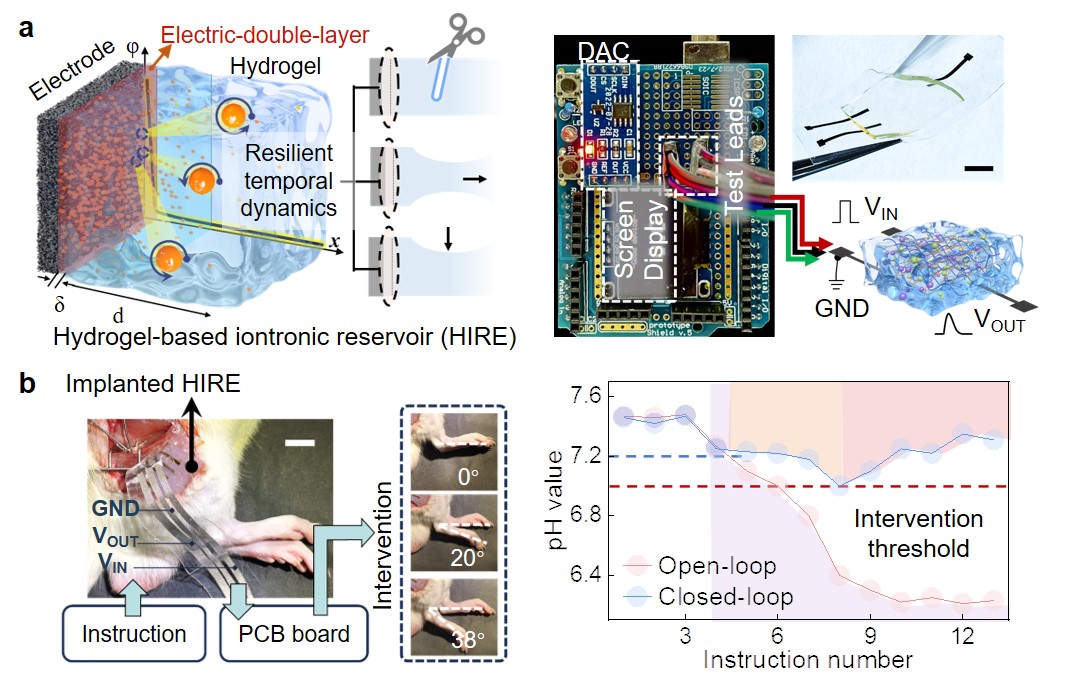
Figure 2. a) Conceptual design of ontronic reservoir (left) and the testing system (right); b) Closed-loop artificial sensorimotor loop (left) and execution regulation results (right).
