
With the advance of unmanned aerial vehicles (UAVs) and low earth orbit (LEO) satellites, the space-air-ground integrated network (SAGIN) has become a promising paradigm in the sixth generation (6G) wireless communication networks to provide full coverage of 3D spatial network and seamless high-capacity interconnection whenever and wherever. Motivated by the great potential, both academia and industry have paid increasing attention to the research and development of SAGIN. However, due to the complex network architecture, high mobility, and dynamic network conditions and demands of SAGIN, many challenges also need to be addressed in this new paradigm, such as network topology management, resource management, service management and mobility management. Furthermore, since real-world deployment for testing of SAGIN is difficult and prohibitive, a comprehensive and efficient SAGIN simulation platform is requisite.
1. Network Topology Management
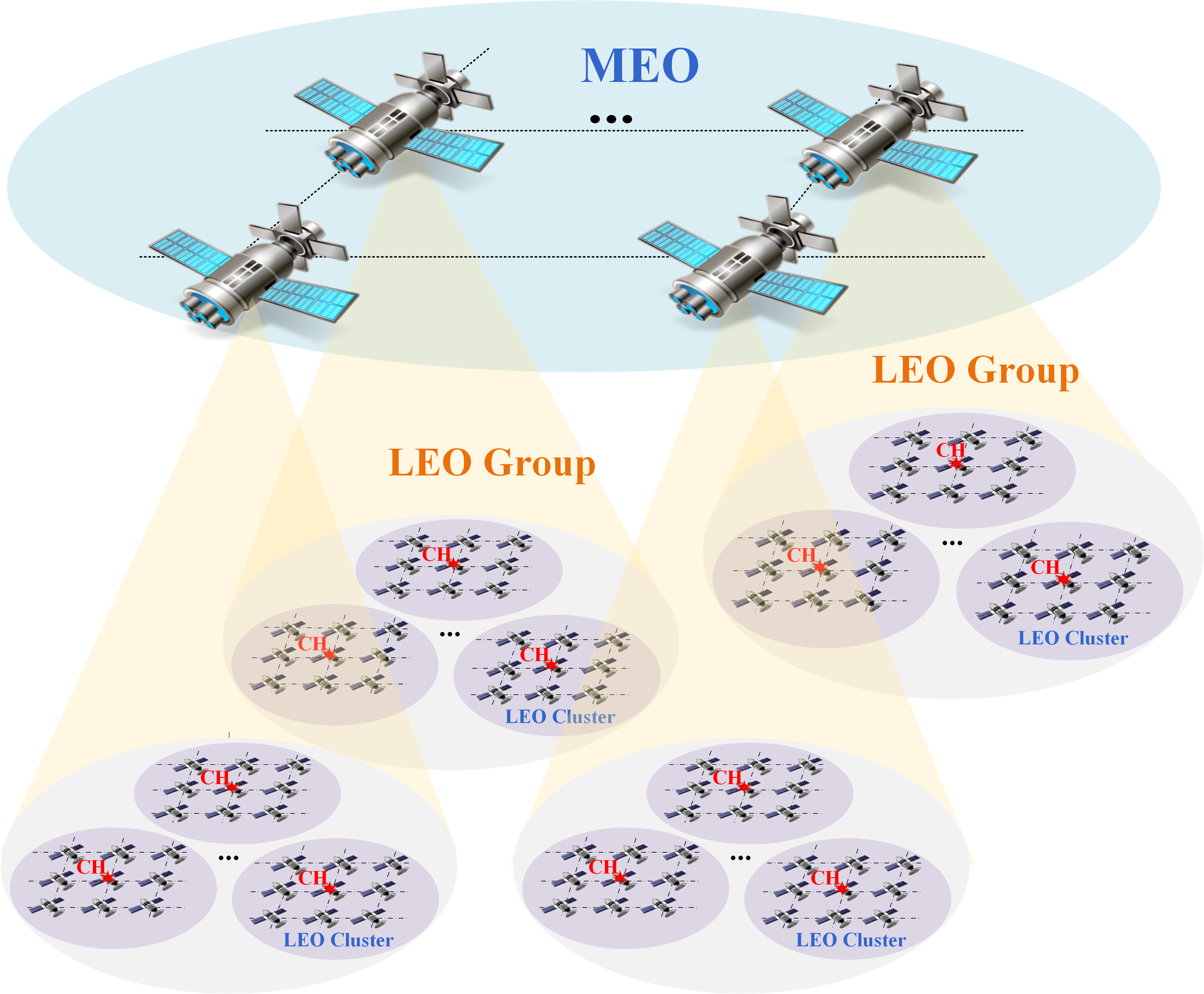
For the SAGIN, its network performance management is of great significance to ensure network robustness and service capability. However, the SAGIN is usually composed of multiple network segments, which have the characteristics of natural heterogeneity, high dynamics of aerial nodes, large temporal and spatial scale, and time-varying status. Therefore, it is challenging but significant to establish an efficient and lightweight management system for the SAGIN.
2. Resource Management
For the SAGIN communication system, especially for the aerial network, the link resource, energy resource and cache resource are extremely scarce and valuable. Therefore, how to effectively manage and allocate network resources is an urgent problem. Meanwhile, considering the rapid change of aerial network topology, the high mobility of aerial nodes (such as UAVs or LEO satellites), the change of terminal service load, etc, it is urgent to explore efficient methods to reasonably and effectively allocate resources for end users.

3. Service Management
Nowadays, the SAGIN is able to support more and more services, such as Internet of things (IoT), Internet of Vehicles (IoV), remote surveillance, and ultra telemedicine collaboration, etc. These services admit their own different key performance index (KPI) characteristics. Facing the dynamic and diverse services, we can comprehensively enhance the network performance and service capability of the SAGIN.

4. Mobility Management
Considering the mobility of the aerial network, the mobility management of the SAGIN faces the following new challenges. For the end user, it has the location movement and the change of service requirements. For the aerial network, the high mobility of aerial nodes results in the change of network states such as channel state and network congestion. Thus, we need to implement effective mobility management to ensure the service continuity.

5. SAGIN Simulation Platform
Until now, most existing works focus on evaluating either only one single network segment in space, air, or ground, or the integration of space-ground or air-ground
network. To provide a solid basis for testing of SAGINs, a lightweight and comprehensive SAGIN simulation platform that addresses the challenge of integrating the space, aerial, and ground networks is urgent to be developed.
