
With the rapid growth of artificial intelligence, the Internet of Things, and intelligent sensing, edge devices must continuously process large volumes of temporal data generated by sensors such as dynamic vision and audio systems. Physical reservoir computing (PRC) harnesses the intrinsic nonlinear responses and short-term memory of physical devices to process time-dependent information, offering a promising hardware route toward low-power intelligence near the sensor. Most existing physical reservoir systems, however, operate on segmented inputs and reinitialize device states between samples. In real-world continuous event streams, devices with multiscale memory may accumulate residual states from earlier inputs, shifting the operating baseline and undermining the stability of long-duration inference.
Recently, a team led by Professor Linwei Yu at Nanjing University developed a reset-aware physical reservoir computing approach based on Schottky silicon nanowire field-effect transistors (SiNW-FETs) grown by the in-plane solid-liquid-solid (IPSLS) mechanism. By exploiting source-drain polarity control, the researchers realized decoupled gate-write/polarity-erase operations. Applying a reverse source-drain bias on demand actively restores the device baseline and suppresses state drift during continuous event-stream processing, providing a new device-level route to stable, long-term physical reservoir computing.
1 Deterministic IPSLS Growth Enables Addressable SiNW-FET Arrays
Bottom-up nanowire synthesis typically requires subsequent transfer and assembly, whereas top-down fabrication of ultrathin nanowires depends on high-resolution nanoprocessing. Both routes complicate large-scale integration of nanowire devices. The team used the IPSLS method to guide directional nanowire growth along predefined step structures at designated locations. Combined with lithographically defined electrodes and interconnects, this approach enabled an addressable 4 × 4 top-gated SiNW-FET array.
The fabricated silicon nanowires had a typical diameter of approximately 20 nm; statistics from 55 nanowires gave a mean diameter of 22.5 ± 4 nm. All 16 devices in the array exhibited consistent p-type gate modulation, with an on/off ratio of approximately 10⁶, an off-state current on the order of 10⁻¹² A, and a subthreshold swing of approximately 180 mV dec⁻¹.
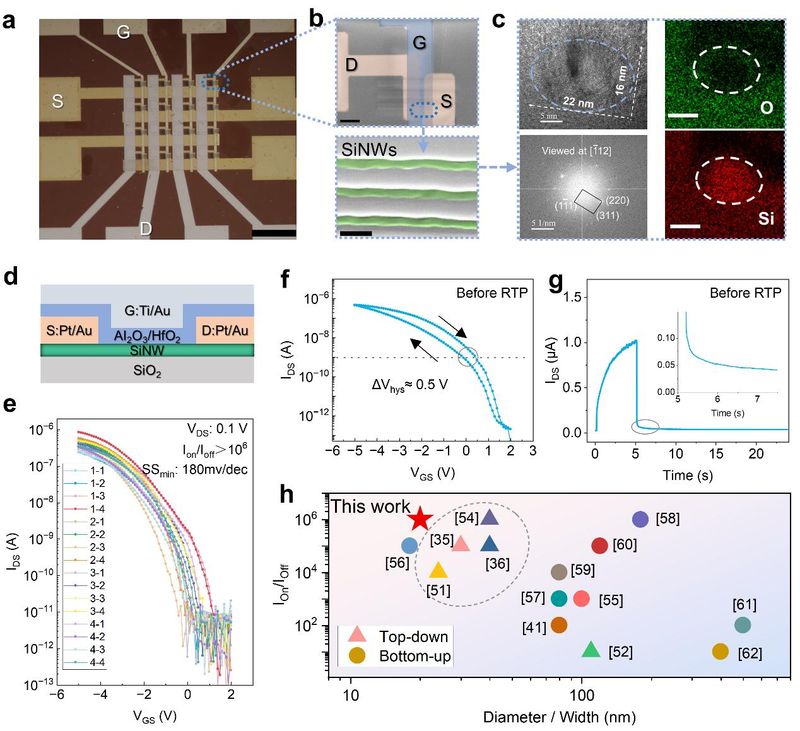
Figure 1. Addressable SiNW-FET array fabricated by IPSLS growth and its dynamic characteristics.
2 Polarity-Programmed Reset Decouples Writing from State Management
Under forward source-drain bias, gate pulses continuously tune the SiNW-FET state. After each stimulus, the response decays on both fast and slow timescales, providing dynamic memory for temporal information processing. To prevent slow states from accumulating under continuous input, the team introduced reset through a reverse source-drain bias. Unlike schemes that use the gate for both writing and erasing, this method assigns information input to the gate and state recovery to source-drain polarity. The two operation channels are therefore decoupled, restoring the operating baseline while minimizing disturbance to subsequent write trajectories. The reset response remained stable for more than 50,000 cycles.
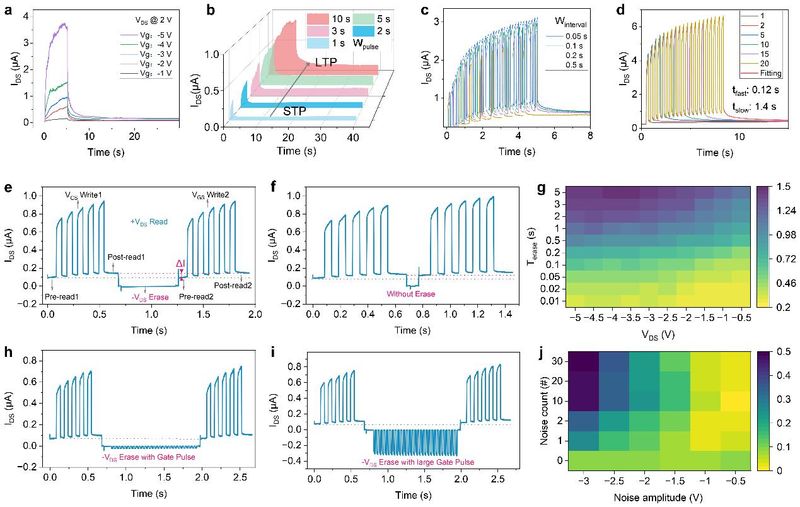
Figure 2. Pulse dynamics of the SiNW-FET and the gate-write/polarity-erase operation.
3 Barrier-Trap Coupling Governs the Polarity-Dependent Dynamics
The polarity-dependent behavior originates from coupled regulation of interfacial traps and the Schottky barrier. Under forward source-drain bias and negative gate pulses, charge in the interfacial traps alters the local electrostatic potential and modulates the carrier-injection barrier at the Schottky contact, producing a history-dependent conductance state. Reversing the source-drain bias redistributes the local electric field and the dominant injection region, promoting re-equilibration of trap states in the barrier-sensitive region and returning the current toward its baseline. Source-drain polarity thus provides an independent degree of freedom for state control, distinct from the gate input, and supplies the device-level basis for active state management in reservoir computing.
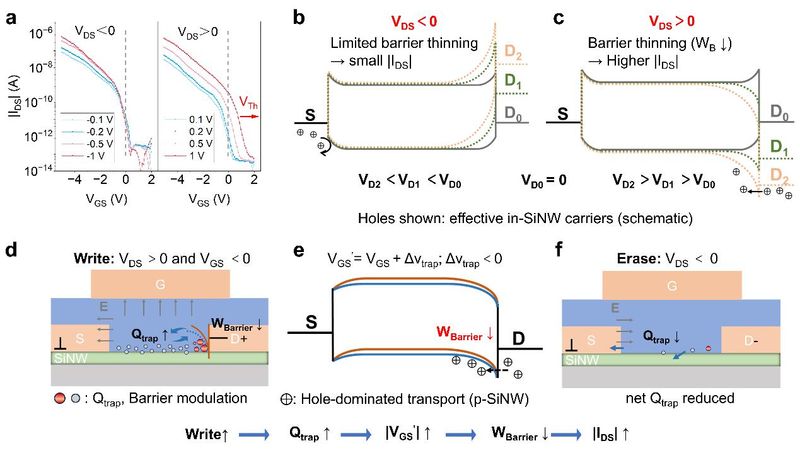
Figure 3. Polarity-dependent Schottky barrier-interfacial trap coupling mechanism for writing and reset.
4 Continuous Event-Stream Recognition Demonstrates Long-Term Stability
Using experimentally measured device dynamics, the researchers built a continuous event-stream reservoir computing model for the DVS128 Gesture event-based vision dataset, achieving an overall gesture-recognition accuracy of 91.6%. Without reset, residual states accumulated during continuous operation, producing pronounced baseline drift near 200 s and an accuracy drop of approximately 20%. Sparse polarity-addressed resets effectively suppressed long-term state drift and maintained continuous-inference accuracy above 90%. Under slow event-rate drift and burst-like background noise, the time overhead associated with reset remained below 1%.
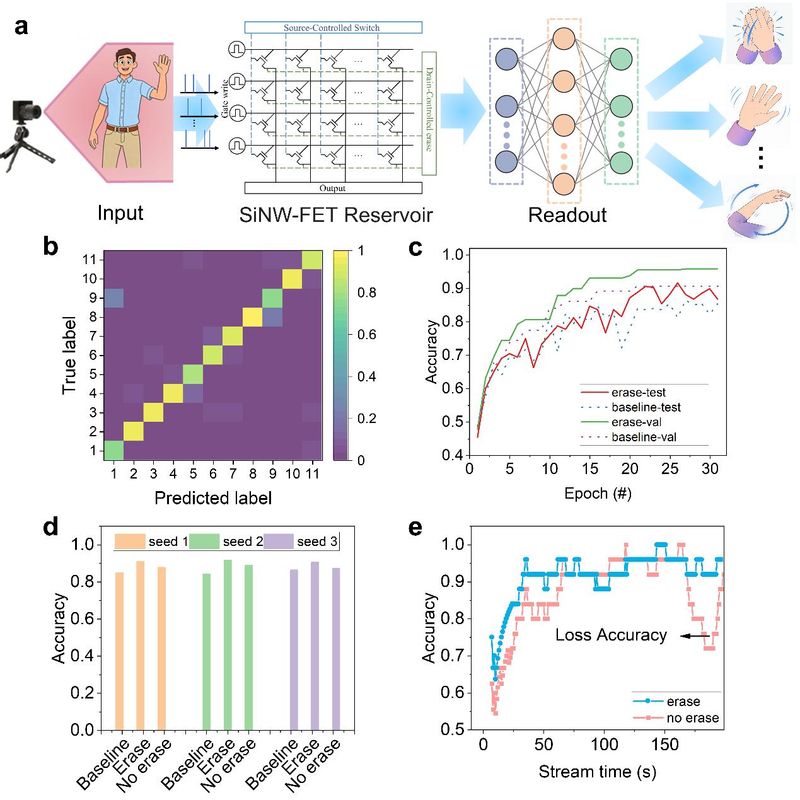
Figure 4. Continuous DVS event-stream gesture recognition using a SiNW-FET reservoir.
Outlook: Toward More Intelligent Computing Hardware
Physical reservoir computing relies on the dynamic memory of devices to process temporal information, but preventing slow states from accumulating during prolonged operation remains a critical challenge for continuous online computing. This work exploits the source-drain polarity degree of freedom in a three-terminal SiNW-FET to electrically decouple information writing from state reset. The device therefore retains useful dynamic memory while gaining the ability to actively recover its operating baseline. Together with the deterministic growth and array-integration advantages of IPSLS silicon nanowires, the study offers a device-array-system co-design strategy for advancing physical reservoir computing from segmented demonstrations to continuous event-stream processing.
The work, titled “Polarity-Addressed Reset Stabilizes Schottky SiNW-FET Reservoir Computing for Continuous Event-Stream Inference,” was published in Advanced Functional Materials. Lei Yan of the School of Electronic Science and Engineering at Nanjing University is the first author. Professor Linwei Yu and postdoctoral researcher Wei Liao are the corresponding authors. The study also benefited from the support and guidance of Professor Kunji Chen, Professor Junzhuan Wang, and Researcher Xiaopan Song of Nanjing University. The work was supported by the National Science Fund for Distinguished Young Scholars, the National Key Basic Research Program, the Natural Science Foundation of Jiangsu Province, and the National Natural Science Foundation of China.
Publication Details
Polarity-Addressed Reset Stabilizes Schottky SiNW-FET Reservoir Computing for Continuous Event-Stream Inference.
Lei Yan, Yifei Zhang, Minghao Wei, Zhiyan Hu, Guanqiao Sang, Wentao Qian, Xiaopan Song, Wei Liao*, Junzhuan Wang, Linwei Yu*.
Advanced Functional Materials
https://doi.org/10.1002/adfm.77601