
Imagine switching the polarity of a superconducting diode as easily as flipping a light switch, all while keeping the external magnetic field completely fixed. A joint research team from Nanjing University, Zhejiang University, and Purple Mountain Laboratories has made this a reality. They have successfully developed a nanoscale electrothermal-switch superconducting diode. By utilizing a tiny gate current, this device can achieve in-situ polarity switching and on/off control under a fixed magnetic field, paving the way for low-power, programmable superconducting electronics and hybrid quantum systems. This significant breakthrough was recently published in the prestigious international journal Nano Letters under the title “Nanoscale Electrothermal-Switch Superconducting Diode for Electrically Programmable Superconducting Circuits”.
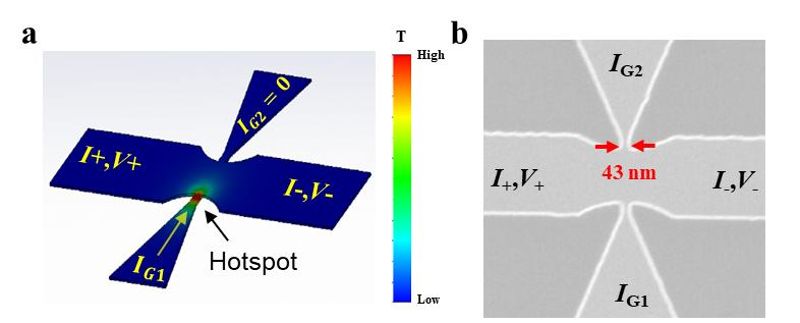
Figure 1: Novel electrothermal-switch superconducting diode: Schematic (a) and scanning electron microscope (SEM) image (b). A tiny gate current generates a localized hotspot on the nanowire, thereby breaking spatial inversion symmetry.
The Bottleneck of Traditional Superconducting Diodes
Superconducting diodes are highly desired devices that allow supercurrents (zero-resistance currents) to flow without dissipation in one preferential direction. They hold immense potential for developing ultra-low-power superconducting circuits and quantum technologies.
However, existing superconducting diodes face critical limitations: they heavily rely on complex heterostructures or delicate interface engineering to achieve their non-reciprocal (one-way) transport, and they typically require active tuning of external magnetic fields to switch their polarity. This reliance on dynamically altering global magnetic fields makes it exceedingly difficult to control individual devices locally, acting as a major roadblock for the large-scale integration and practical application of superconducting circuits.
The Innovation: A Hotspot to Break Symmetry
To overcome the scalability and tunability challenges, the research team drew crucial inspiration from a device known as the superconducting nanowire cryotron (nTron). They designed a four-terminal superconducting nanowire structure utilizing thin films of niobium nitride (NbN).
The ingenuity of their design lies in the nanoscale gate leads placed on the sides of the nanowire. By applying a minute gate current—just tens of microamperes—the researchers can generate a localized nanoscale hotspot. Instead of completely destroying the nanowire's superconductivity, this hotspot creates a controllable thermal gradient. It is exactly this thermal gradient that dynamically breaks the spatial inversion symmetry of the device, successfully triggering the superconducting diode effect in the presence of a baseline magnetic field.
Furthermore, the team discovered that this single mechanism gives rise to two distinct, coexisting non-reciprocal transport regimes within the same device:
· Superconducting-to-Normal Transition Diode Effect (SN-SDE): Operating in a high-dissipation regime, this effect occurs because the critical currents required to break the superconducting state differ depending on the current direction, achieving an efficiency of up to 42%.
· Vortex-Motion Diode Effect (V-SDE): In a low-dissipation regime, the diode effect is driven by the ratchet-like dynamics of quantized magnetic flux vortices, boasting an impressive efficiency of up to 60%.
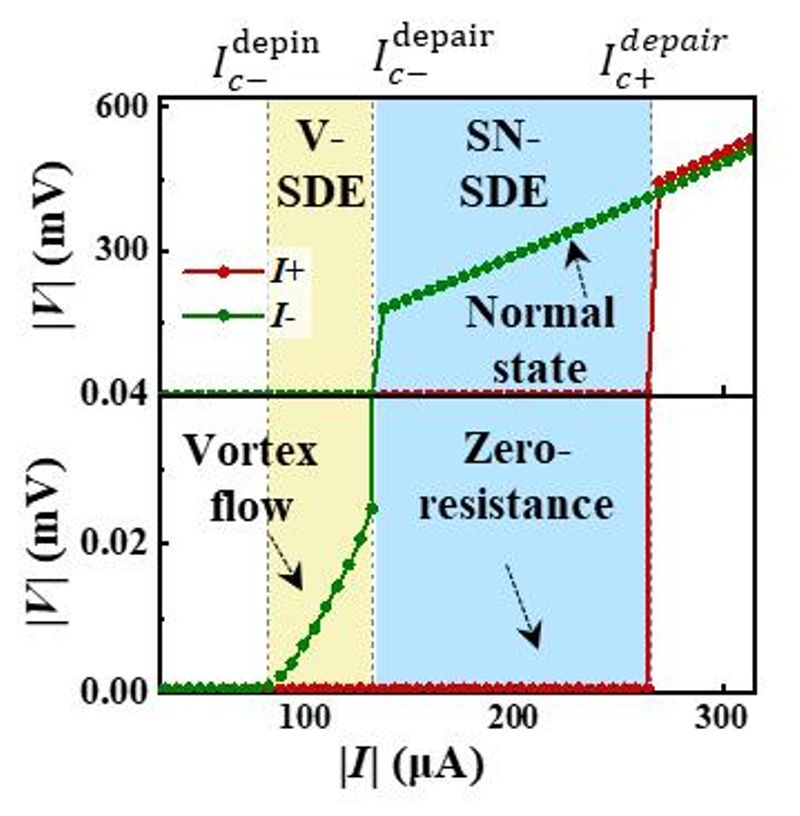
Figure 2: Current-voltage characteristics exhibiting two superconducting diode effects: the superconducting-to-normal transition diode effect (SN-SDE, blue region) and the vortex-motion diode effect (V-SDE, yellow region).

Figure 3: Programmable superconducting diode: Controlling the hotspot location enables the polarity reversal and on/off switching of the superconducting diode.
In-Situ Electrical Control: On-the-Fly Reprogramming of Superconducting
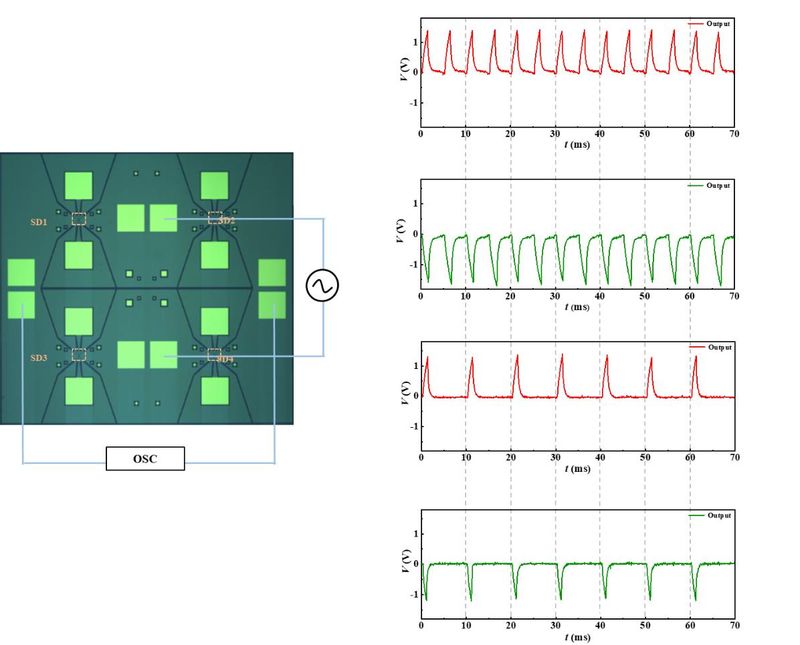
Figure 4: Multifunctional programmable superconducting circuit application. An electrically programmable superconducting circuit array composed of four electrothermal-switch diodes (left). Through electrical commands, this circuit can be flexibly switched between full-wave rectification (forward/reverse) or half-wave rectification (forward/reverse) (right).
Circuits
Thanks to this unique electrothermal-switch mechanism, the diode exhibits unprecedented flexibility. Operating under a fixed magnetic field, researchers no longer need to sweep or adjust magnets to tune the device. By simply changing the current applied to the different side gates, they can instantly turn the diode effect on or off, or completely reverse its conducting polarity.
To demonstrate the immense potential of this device, the team used standard micro/nanofabrication techniques to integrate four identical electrothermal-switch diodes, constructing a multifunctional, electrically programmable superconducting bridge rectifier. Using simple electrical commands without modifying the magnetic field, this circuit can be reconfigured in real-time to switch freely between full-wave rectification and half-wave rectification modes.
Future Outlook
This work not only establishes a unified microscopic physical framework for understanding electrothermally driven non-reciprocal superconductivity, but more importantly, it provides a highly practical solution to the scalability and controllability bottlenecks of superconducting devices.
With its high performance, convenient gate-controlled functionality, and inherent compatibility with existing lithography techniques, this nanoscale electrothermal-switch diode is set to play a core role in future technologies. It opens new doors for the development of highly energy-efficient superconducting logic circuits, neuromorphic computing, and electrically reconfigurable quantum information systems.
This research was led by the Research Institute of Superconductor Electronics at Nanjing University, in collaboration with Zhejiang University and Purple Mountain Laboratories. The work received support from the Quantum Science and Technology-National Science and Technology Major Project, the National Key R&D Program, and the National Natural Science Foundation of China, among others.